
What Submersible Pump Should You Choose for Your Water Treatment?

Quick answer. For a water treatment plant, choose the submersible pump by the largest solid in the liquid first. Clean water with no solids suits the openwell pump, which runs from 0.5 HP to 15 HP with head up to 60 m. Dirty water with solids up to 10 mm suits the dewatering pump, which goes up to 50 HP. Sewage and sludge with solids of 35 mm to 100 mm need the sewage pump, which goes from 1 HP to 100 HP or higher. Keep a portable pump for shutdowns and emergency drainage. Then confirm the model against your flow and total head with the pump selector.
A water treatment plant never pumps just one liquid. Clear water leaves the storage tank, backwash water carries fine sand to the drain pit, raw sewage arrives at the inlet sump and sludge settles at the bottom of a tank. Each of those liquids needs a different submersible pump, and the wrong pick shows up as a clogged impeller, a tripped motor or a leaking seal.
This guide matches the pump to the stage of the plant. It starts with the liquid and the solids, moves to flow and head, and finishes with materials and protection. The four pump types come from the Sando submersible range, and each pump below links to its product page.
Decide in this order. Pump type comes first, the duty point (flow and head) second and materials third. Plants that start from motor power usually end up with a pump that suits the water but not the solids.
Why use submersible pumps in a water treatment plant?
Because most pumping in a treatment plant happens below the liquid level, in sumps, wet wells, tanks and pits, and a submersible pump works there without priming.
A submersible pump sits inside the liquid it moves. The motor is sealed in a watertight housing, the impeller adds velocity, and the casing turns that velocity into pressure. Because the pump is already under the surface, it needs no priming, and the surrounding liquid cools the motor while it runs.
That makes it a natural fit for sumps, wet wells, tanks and pits, which is where most of a treatment plant's pumping happens. It also means the pump depends on the liquid around it for cooling, so level control, cable protection, seal condition and motor protection matter as much as the pump itself.
Which submersible pump goes where in a water treatment plant?
The stage of the plant tells you the liquid, and the liquid tells you the pump. Use this table as a starting point, then confirm it with your own duty data. For the wider picture, see how submersible pumps for water and wastewater duty are applied across a plant.
| Plant stage | What the liquid carries | Pump to look at | What to watch |
|---|---|---|---|
| Treated water tank, clear water reservoir, open intake well | Clean water, no solids | Openwell pump | Stay inside the pH and temperature limits of the pump |
| Filter backwash and drain pits | Water with fine sand and silt | Dewatering pump | Seal type and impeller wear from sand |
| Plant drainage, stormwater, trenches, basements | Rain and groundwater, some mud | Dewatering pump or portable pump | Cable length, float or level control, duty cycle |
| Raw sewage inlet sump and lift station | Soft solids, rags and fibres | Sewage pump | Solids passage and impeller style |
| Sludge sump and settled solids | Heavy, abrasive sludge | Sewage pump with a solids and abrasion check | Abrasion, solids concentration and impeller clearance |
| Chemical effluent and neutralisation pit | Acidic, alkaline or chloride rich liquid | Stainless or super duplex construction in the pump style that suits the solids | pH, concentration and a full compatibility check |
| Shutdown draining and temporary transfer | Mixed, changes by job | Portable pump | Weight, hose connection and how fast it can be set up |
Which pump for which solid size?
The largest solid in the liquid rules out pumps faster than flow or power does. Use this ladder, which is built from the solids ratings Sando lists for each pump.
| Largest solid in the liquid | Start with | Why |
|---|---|---|
| None, clean water | Openwell pump | No solids duty, with pH 6.5 to 8.5 and liquid up to 33 °C |
| Up to 10 mm, such as sand and silt | Dewatering pump | Listed for suspended solids up to 10 mm, with SiC seal and high chrome impeller options |
| Above 10 mm and below 35 mm | Check with the Sando team first | The listed ratings jump from 10 mm to 35 mm, so this band needs a model check against your liquid |
| 35 mm to 100 mm, such as rags and fibres | Sewage pump | Wide passage or vortex impeller built to pass solid waste |
The portable pump sits outside this ladder because it is chosen for how it is used, not for the solid it passes. It is the pump you move between sumps during shutdowns and emergencies.
Which five questions decide the pump?
Answer these five before you look at any model.
- What is the liquid? Name it, then note the pH, temperature, viscosity and how corrosive it is. This decides the pump type and the materials.
- What solids does it carry? Note the largest particle, not the average. A pump passes the biggest solid in the liquid or it clogs.
- What flow do you need? Use the real peak flow, in LPM or m3/hr, not a rounded guess.
- What is the total head? Add the vertical lift, the pipe friction, the losses at bends and valves, and any pressure needed at the outlet.
- How will it be installed and run? Sump depth, cable length, outlet size and daily running hours all change the choice.
Everything else in this guide builds on those five answers.
Which Sando submersible pump suits your water treatment duty?
Sando Rotary Equipments, an Indian manufacturer, makes four submersible pump types for this work. Each card below gives the listed range and says where the pump should not be used.
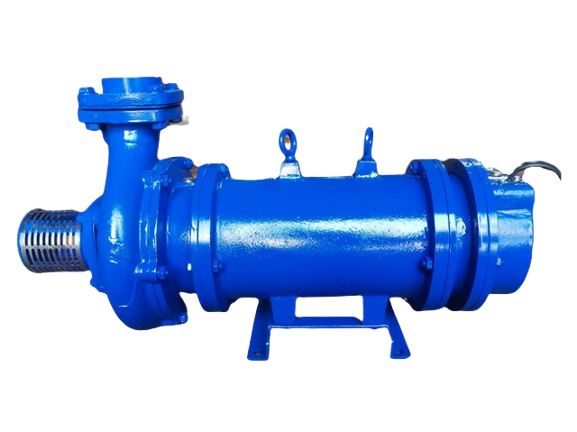
Openwell submersible pump
A centrifugal pump built to run fully submerged in open wells, tanks and reservoirs where the water level stays fairly steady. It is the pump for clean water transfer and circulation.
- Power from 0.5 HP to 15 HP
- Flow of about 50 LPM to 1000 LPM
- Head of 5 m to 60 m, outlets from 25 mm to 100 mm
- Liquid up to 33 °C, pH 6.5 to 8.5, specific gravity up to 1.004
- Single phase 220 V to 240 V or three phase 380 V to 415 V
Use it for treated water storage, clear water reservoirs and intake wells with clean water. Do not use it for sewage, sludge or any liquid with solids, or when the liquid falls outside the pH and temperature limits.
View openwell pump specifications
Dewatering submersible pump
A heavy-duty pump for removing dirty, muddy and sandy water from pits, trenches, basements and process sumps. It handles small solids and runs continuously.
- Power from 0.5 HP to 50 HP
- Flow up to 1200 LPM and head up to 60 m
- Suspended solids up to 10 mm
- Liquid up to 40 °C, IP68 motor, continuous duty (S1)
- Double mechanical seal and thermal overload protection
- Options: SS304 or SS316 construction, high chrome impeller for abrasive slurry, SiC vs SiC seal for sandy water, Viton or EPDM elastomers for chemicals
Use it for filter backwash pits, plant stormwater, trenches and basements around the plant. Do not use it for raw sewage with rags and fibres. Heavy rain also brings its own failure patterns, covered in pump failure during heavy rainfall events.
View dewatering pump specifications
Portable submersible pump
A compact pump that one crew can carry and set up quickly. It moves water, wastewater and light slurry, and it is the one to keep for shutdowns and emergencies.
- Power from 1 HP to 20 HP, 3000 RPM, continuous duty squirrel cage motor
- 220 V single phase for 1 HP to 3 HP, 415 V three phase for 1 HP to 20 HP
- Direct on line starting, star delta optional, class F insulation, IP68
- Cast iron casing and impeller, stainless steel shaft, TC vs TC or SiC vs SiC mechanical seal
- Float switch available for automatic operation, or manual control
- Stainless steel, aluminium or bronze construction on request
Use it for draining tanks and clarifiers during shutdowns, emergency drainage and temporary transfer between sumps. Choose something else for continuous raw sewage duty, where a dedicated sewage pump is the better tool.
View portable pump specifications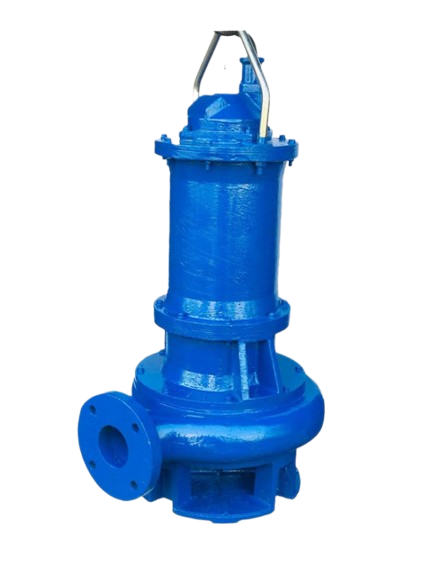
Sewage submersible pump
A heavy-duty centrifugal pump for sewage, wastewater and sludge. Wide impeller passages or a vortex impeller let solid waste and fibres pass without clogging.
- Power from 1 HP to 100 HP or higher
- Flow of about 50 LPM to 5000 LPM, with larger models going higher
- Head of 5 m to 50 m, discharge from 50 mm to 200 mm
- Solids of 35 mm to 100 mm, depending on impeller type and pump size
- 1450 to 2900 RPM, liquid up to 40 °C, IP68 motor, continuous duty (S1)
- Three phase 380 V to 415 V, with single phase on smaller models
Use it for inlet sumps, lift stations, effluent collection sumps and sludge transfer. Be careful with abrasive sludge. High solids concentration needs an impeller and material choice made for that duty.
View sewage pump specificationsOpenwell vs dewatering vs portable vs sewage pump
| Pump type | Best liquid | Solids | Power range | Flow and head | Typical water treatment use |
|---|---|---|---|---|---|
| Openwell | Clean tank, well and reservoir water | None | 0.5 HP to 15 HP | About 50 to 1000 LPM, 5 to 60 m | Treated water storage and transfer |
| Dewatering | Dirty, muddy and sandy water | Up to 10 mm | 0.5 HP to 50 HP | Up to 1200 LPM, up to 60 m | Backwash pits, stormwater, plant drainage |
| Portable | Water, wastewater and light slurry | Light solids | 1 HP to 20 HP | Confirm on the product page | Shutdowns, emergency and temporary pumping |
| Sewage | Sewage, wastewater and sludge | 35 mm to 100 mm | 1 HP to 100 HP or higher | About 50 to 5000 LPM, 5 to 50 m | Lift stations, STP and ETP sumps, sludge transfer |
How do you size a submersible pump for your duty point?
Size it from the duty point, which is the flow you need at the total head the pump must overcome.
The duty point is the flow you need at the total head the pump must overcome. Get it wrong and every other choice is built on sand.
Total head is the vertical lift from the lowest liquid level to the discharge point, plus the friction in the pipe, plus the losses in bends and valves, plus any pressure needed at the outlet. Pipe length, diameter and the number of fittings all push it up.
Worked example. A treated water tank must send 40 m3/hr to an overhead tank. That is about 667 LPM. The lift is 12 m and the pipe and fittings add about 3 m of friction, so the total head is about 15 m. A duty of about 667 LPM at 15 m sits inside the listed flow and head range of the openwell pump, so the next step is to share the duty with the Sando team and pick a model that meets it comfortably, not one that only just reaches it.
Two habits save trouble later. Use the real peak flow and not a rounded number, and pick a model that meets your duty point comfortably, not one that only just reaches it. Once you have your flow, head and liquid details, the pump selector and the pump manual help you narrow the model.
Which material should a submersible pump use for effluent and sewage?
Use cast iron for general water, drainage and sewage, SS304 for cleaner water, SS316L for chemical effluent and chlorides, and super duplex for marine and aggressive duty.
The right submersible pump for an application depends heavily on the liquid. The material of construction protects uptime and service life, and it is where many plants save money in the wrong place.
| Material | Suits | Water treatment use |
|---|---|---|
| Cast iron | General industrial water, drainage, sewage and non-corrosive wastewater | Municipal and plant sumps, sewage lift stations, general drainage |
| SS304 | Cleaner water and mildly corrosive industrial liquid | Process water and treated water transfer |
| SS316L | Chemical effluent and chloride exposure, with better pitting resistance | Chemical effluent sumps and ETP duty, after a compatibility check |
| Super duplex | Aggressive, marine or high chloride environments | Seawater duty and severe corrosive cases |
The seal and the impeller need the same attention as the casing. A silicon carbide against silicon carbide seal suits sandy water, a high chrome impeller suits abrasive slurry, and Viton or EPDM elastomers suit chemical duty. If the liquid is acidic, alkaline or chloride rich, check every wetted part against the chemical compatibility guide before you settle on stainless steel.
How do you stop a submersible pump from failing in the sump?
A submersible pump runs unattended, so the protection around it decides how long it lasts. The motor depends on the liquid for cooling, which makes dry running one of the fastest ways to lose a pump.
- Level control. Set the stop level so the motor stays covered and cooled. A float switch or level sensor turns the pump off before it runs dry.
- Thermal and overload protection. Set the panel correctly so an overload trips the pump before the winding takes the damage.
- Seal and moisture monitoring. A worn seal lets liquid reach the motor. Moisture monitoring catches it early.
- Cable protection. Support the cable and keep it clear of sharp edges, the discharge line and moving liquid. Check the cable entry on every service.
- Temperature limits. Hot liquid and hot weather both add to the motor load, as covered in pump motor overheating in hot summer conditions.
When a motor does fail, the cause is usually visible in the winding and the seal. Submersible pump motor burnout explains how to read it.
Common mistakes when selecting a submersible pump
- Choosing by motor power alone. Horsepower says nothing about solids passage, material or the duty point.
- Using a clear water pump on dirty water. An openwell pump has no solids duty, and it will clog or wear out in sewage.
- Sizing for the average solid. Size for the largest one in the liquid.
- Ignoring the limits on the data sheet. Temperature, pH and specific gravity limits are real limits, and openwell pumps in particular have narrow ones.
- Picking stainless steel without a compatibility check. Chloride and chemical exposure can attack the wrong grade.
- Skipping level control. It is the cheapest protection a pump can have.
- Forgetting the power supply. Check whether the site has single phase or three phase before you fix the model.
The same mistakes show up again in service. Common submersible pump problems and solutions shows what they look like in the field.
Which pump should you choose? A quick decision path
- Is the liquid clean water with no solids, within pH 6.5 to 8.5 and 33 °C?
→ Look at the openwell pump. - Is it dirty, muddy or sandy water with solids up to 10 mm?
→ Look at the dewatering pump. - Do you need to move the pump between sumps, or keep it for shutdowns and emergencies?
→ Look at the portable pump. - Does it carry sewage, rags, fibres or sludge?
→ Look at the sewage pump and check the solids passage against your largest particle. - Is it acidic, alkaline or high in chlorides?
→ Choose SS316L or super duplex and run a full compatibility check.
What decides the cost of a submersible pump for water treatment?
The price of a submersible pump depends on the duty, not on one list price. These are the things that move a quote, and each one is covered by the data you send.
- Pump type. A clean water pump, a dewatering pump and a sewage pump are built differently, so they are priced differently.
- Motor power and head. A higher flow at a higher head needs a larger motor and a larger pump.
- Material of construction. Cast iron, SS304, SS316L and super duplex sit at different cost levels, and the liquid decides which one is safe to use.
- Seal and impeller choice. A silicon carbide seal or a high chrome impeller for sandy or abrasive water is an option that changes the build.
- Supply and controls. Single phase or three phase, starting method, and extras such as a float switch.
Most plants get the best result by sending the full duty once, so the team can quote the right pump the first time. You can also view available pumps on the Sando marketplace.
What should you ask a submersible pump manufacturer before ordering?
Ask for the figures that decide whether the pump will survive your liquid. Any supplier should be able to give you these in writing.
- The largest solid the pump passes, not just the motor power.
- The liquid limits on the data sheet, which are temperature, pH and specific gravity.
- The seal type and the material of the casing, impeller and shaft.
- The motor protection fitted, such as thermal overload and the enclosure rating.
- The duty data they need from you to recommend a model.
Sando publishes these limits for its submersible pump range on each product page, so you can check a model against your liquid before you send an enquiry.
What to send to get a submersible pump quote
Share these details and an engineer can recommend a model without going back and forth.
Duty
- Required flow in LPM, m3/hr or GPM
- Total head including friction losses
- Operating hours per day
Liquid and solids
- Liquid name, pH, temperature, viscosity and corrosiveness
- Particle size, concentration and abrasiveness of solids
Installation
- Sump depth and cable length
- Outlet size
- Single phase or three phase supply
- Material preference, cast iron, SS304, SS316L or super duplex
Send those details through the enquiry form and the team will come back with a recommendation. If you are still choosing between pump types, start with the pump selection guide.
Frequently asked questions
Which submersible pump is best for a water treatment plant?
No single type is best, because the plant pumps different liquids at different stages. Openwell pumps suit clean water, dewatering pumps suit dirty water with small solids, portable pumps suit shutdowns and emergencies, and sewage pumps suit raw wastewater and sludge.
Can one pump handle both clean water and sewage?
It is not a good idea. A sewage pump is built to pass solids and a clean water pump is not. Using the wrong one costs you in clogging, wear and downtime.
How do I size a submersible pump?
Find the flow you need and the total head, which is lift plus pipe friction plus fitting losses plus outlet pressure. Then choose a model that meets that duty, and check the solids and material for your liquid.
What material should I choose for effluent with chlorides?
SS316L is the usual choice for chemical effluent and chloride exposure, and super duplex suits aggressive, marine or high chloride duty. Confirm the exact liquid with a compatibility check before you order.
How large a solid can a submersible pump pass?
It depends on the pump type. Dewatering pumps handle suspended solids up to 10 mm, and sewage pumps pass solids of about 35 mm to 100 mm depending on the impeller and the pump size. Always check against the largest solid in your liquid.
Do I need a float switch or level control?
Yes. Level control keeps the motor covered and cooled and stops the pump before it runs dry. Portable pumps are available with a float switch for automatic operation or with manual control.
Why do submersible motors burn out?
The common causes are dry running, overload, a failed seal that lets liquid reach the winding, and damaged cable. Level control, correct panel settings and regular seal checks prevent most of them.
Should I choose a single phase or three phase pump?
Match the supply at your site. Smaller openwell, dewatering and portable pumps are available in single phase, while larger pumps and most sewage pumps run on three phase 380 V to 415 V.
Sando Editorial Team
The Sando Editorial Team consists of pump technology experts and engineers at Sando Rotary Equipments, dedicated to sharing insights and innovations in the fluid handling industry.
About Sando
Leading manufacturer of industrial pumps and valves for diverse industries worldwide.
Learn more →